It Moves Co.
The It Moves Co flagship

Rampline

Flight operations hub

In-house only · Never for release

Rampline reconstructs what's happening at six major airports, every flight, every gate, every grounded jet, from the public signals aircraft broadcast, with no airline feed behind it. That picture normally exists in exactly one place: inside the airline.

6airports, live
1,049gates mapped
15 srefresh
0airline data
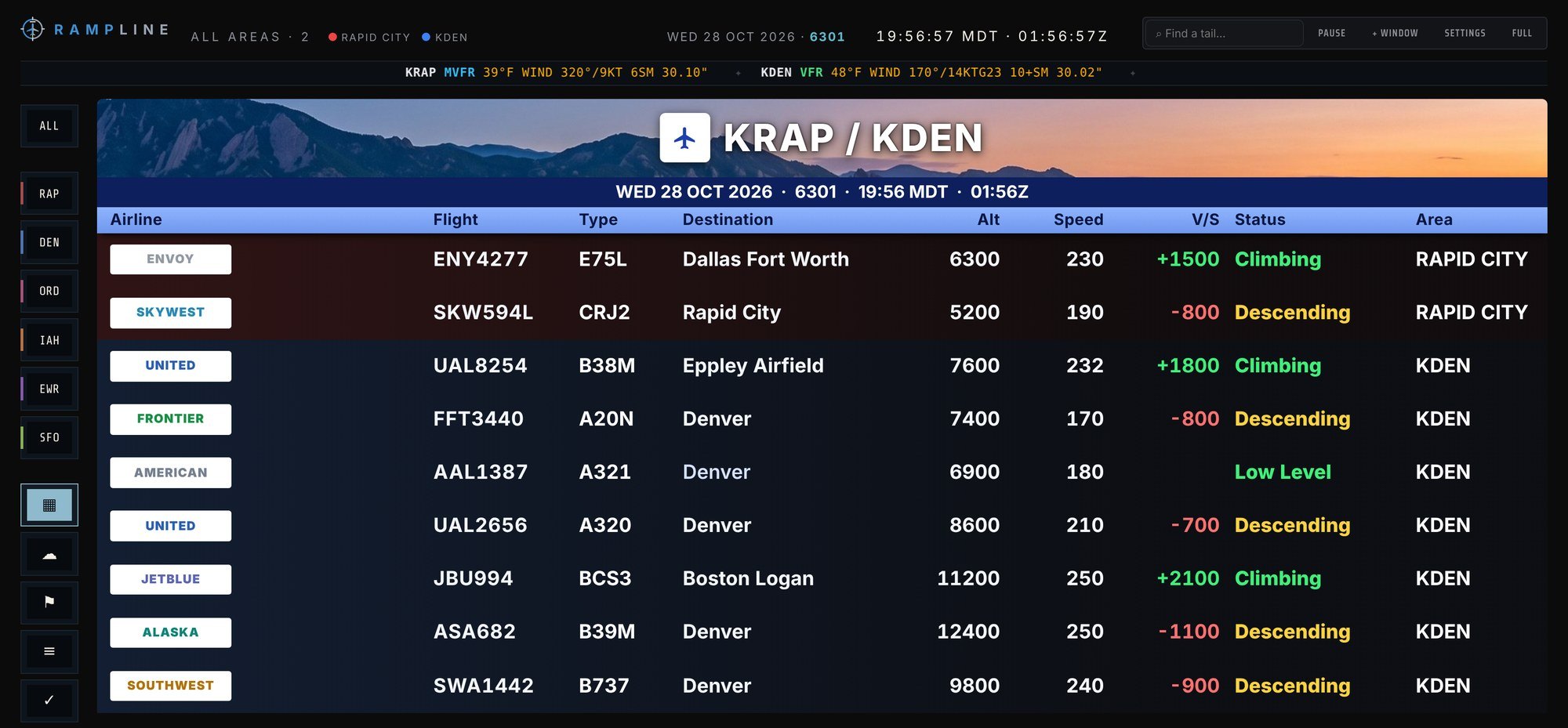
Rampline's main board: a full-width departures-style table headed KRAP / KDEN over a mountain sunset, listing live flights with airline, flight number, aircraft type, destination, altitude, speed, vertical speed and climbing or descending status, color-coded by airport.
The main board. Flights shown are examples.

Nobody tells it anything. It figures it out.

Airlines see this from the inside. Rampline sees it from the outside.

Systems that see this much normally run on expensive commercial flight-data feeds. Rampline does it on free public signals and one small paid schedule service, kept on a strict monthly budget.

An airline operations center
  • Its own schedule and gate assignments
  • Reports from station and ramp staff
  • Maintenance logs from its own mechanics
  • Dispatch and crew systems
  • Years of internal software and a room full of people
Rampline
  • The radio broadcasts every airplane gives off, the same signal anyone's antenna can hear
  • Public weather, delay and map data
  • One small paid schedule log, once a day
  • Everything else, it works out for itself

Same questions. Same answers. No access.

From dots on a map to an operational picture

Every airliner broadcasts who it is and where it is about twice a second. The raw signal is almost nothing: an identity code and a position. Rampline samples those broadcasts around each airport every 15 seconds, fills in the tail number, operator and aircraft type, and keeps watching the same airplanes over and over.

This is the part nothing else does: watching the same airplane over and over and working out what it's doing (landings, gate parks, turns, breakdowns) with nobody telling it anything.

Landed

Airborne, then on the ground. Where antennas can't hear the runway, a jet on short final that goes silent still counts, with its altitude corrected using the field's own altimeter setting.

At the gate

Stopped on a gate's learned stopping point, pointed the right way, still for 45 seconds. Each gate is refined from real stops until Rampline knows it to within a couple of meters.

The turn

Park to pushback: unloading, cleaning, fueling, catering, boarding. One of the numbers airlines live by, measured for every jet at every gate.

Overnight

Parked more than six hours, or still on the ground at 3 a.m. Airline people call it a RON, "remain overnight."

Out of service

Towed under a maintenance call sign, sitting in a hangar area, or silent across several daytime checks. A live list of which jets are down, where, and for how long.

Trouble jet

The same tail going down again and again, sometimes at different airports. Down in Chicago, then down again in Denver.

Equipment swap

A flight number that's normally one airplane shows up with a different one today. It usually means the planned jet broke somewhere.

Hub flow

One tail lands at a hub and launches again within four hours. Newark to O'Hare to Denver: how the airline actually moves its fleet.

Six weeks of watching

Rampline watches Denver, Chicago O'Hare, San Francisco, Newark, Houston and Rapid City, where it began. Since its current logs started in mid-September, it has built a memory most airlines would recognize.

12,111
individual aircraft, each identified by tail number
33,687
gate visits tracked · 30,071 turns, 3,616 overnights
177,016
scheduled flights logged with tail and gate times
8,514
maintenance holds detected · 1,401 confirmed
3,228
flights timed from takeoff at one airport to landing at another
1,049
gates and parking spots mapped

As of 28 October 2026.

Built to live on a wall

Pick an airport and everything about it is in one place. Leave it alone for five minutes and it returns to the big board by itself.

Rampline's Denver overview: a sidebar of six airports with today's traffic and jets down, a sunset photo of Denver International, and panels for aircraft today, jets down, gates occupied, yesterday's fuel estimate, FAA status, gate activity, traffic by airline and weather with a runway wind dial.

One airport, one screen

Aircraft seen today, jets out of service, gates occupied, yesterday's fuel burn and FAA delay status across the top. Below: who's at the gates, the latest gate activity, traffic by airline, and the weather with a runway wind dial.

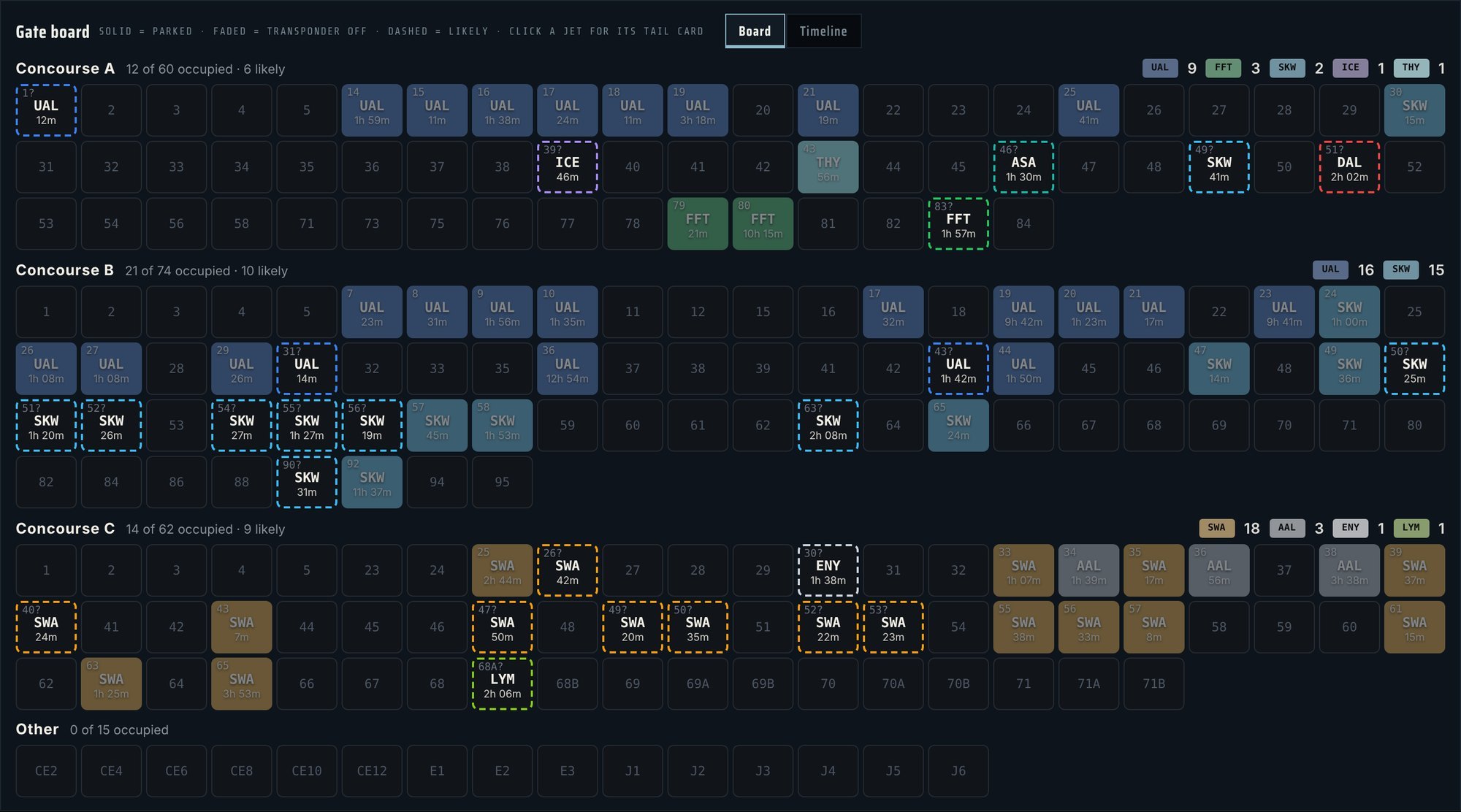
Rampline's Denver gate board: every gate on Concourses A, B and C drawn as a box, filled with the airline color and time on gate when a jet is parked, with dashed outlines for likely occupants.

Every gate at Denver

Each gate is a box that fills with the airline's color when a jet parks. Solid means parked and transmitting, faded means the crew has shut the transponder off, and dashed is Rampline's own inference. Click any jet for the flight it just came in on and the one it's scheduled to fly next.

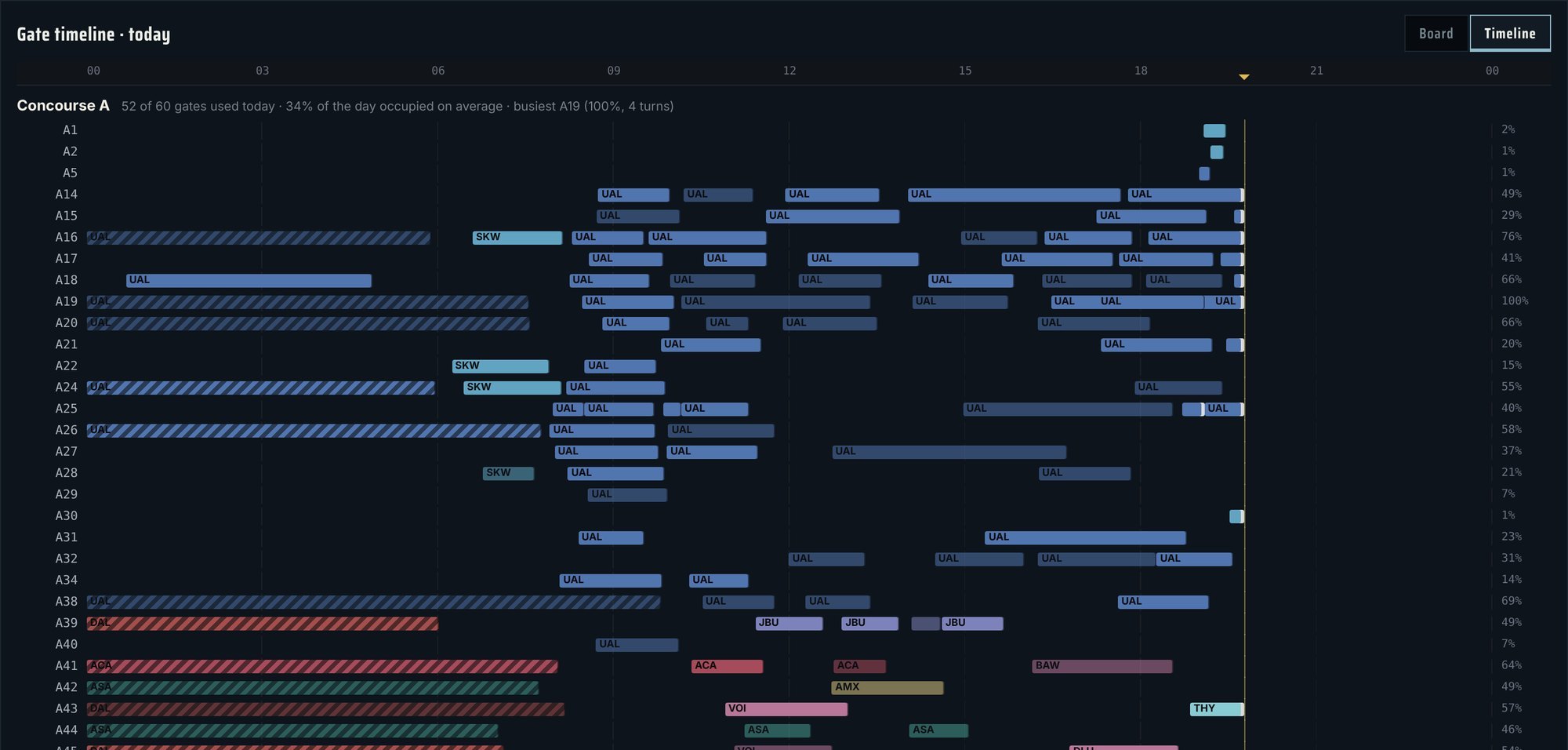
Rampline's gate timeline for Denver Concourse A: one row per gate across a midnight-to-midnight axis, with solid bars for turns and striped bars for overnight stays, labeled by airline, and each gate's share of the day occupied.

The whole day, gate by gate

Each gate becomes a line from midnight to midnight, and every visit is a bar: solid for a turn, striped for an overnight. You can see the morning rush, the gates that sit empty, and the ones that never rest.

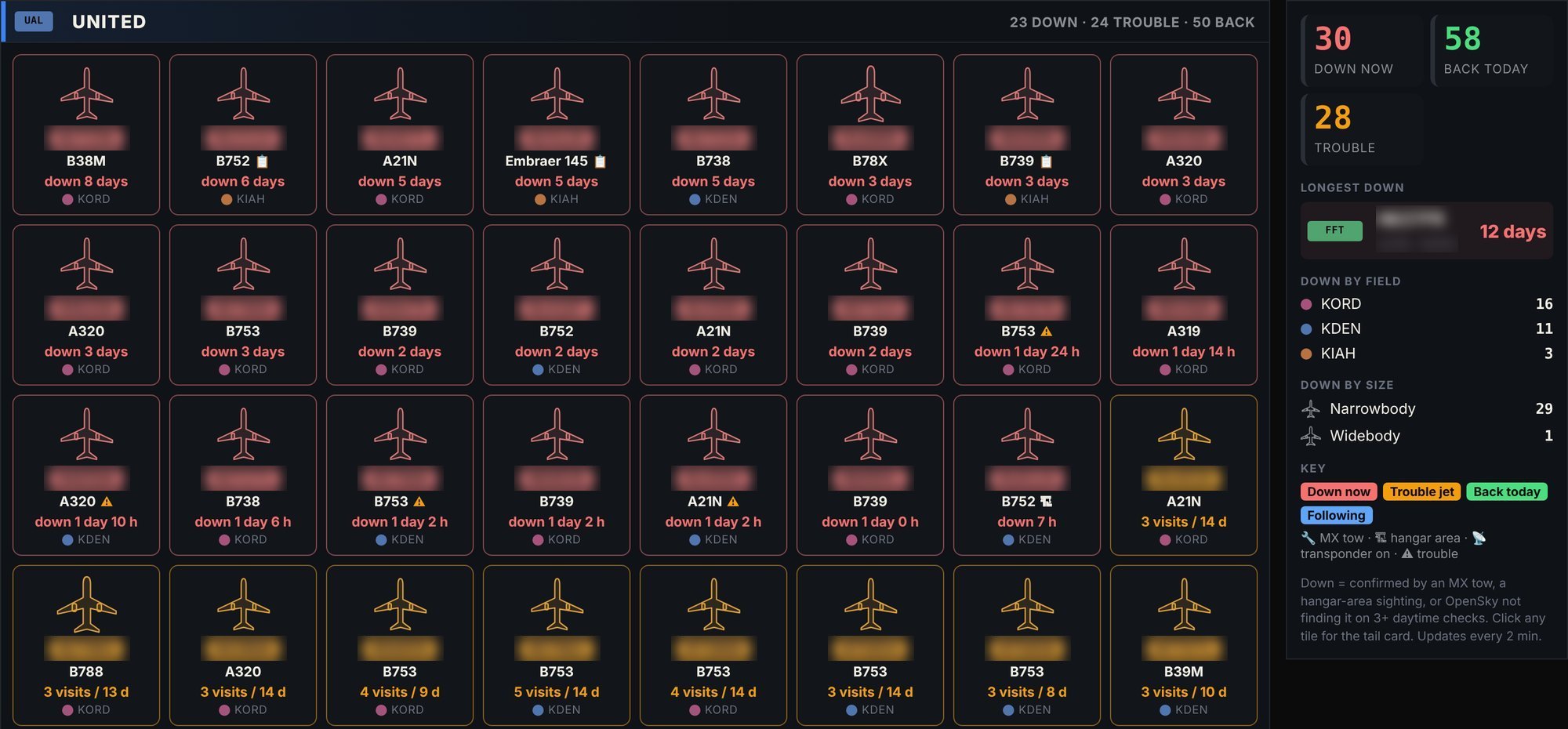
Rampline's maintenance status board: a grid of aircraft tiles, each with a tail number, type, how long it has been down and at which airport, in red for down now and amber for repeat trouble jets, with totals for down now, back today and trouble.

The broken jets

Thirty airliners out of service across three hubs, each one with its type, how long it's been down and where it's sitting. No maintenance log said so. Rampline worked it out from jets towed under maintenance call signs, parked in hangar areas, or gone silent across days of checks, and it flags the "trouble jets" that keep going down at one hub after another. Tail numbers are blurred here. Rampline has every one.

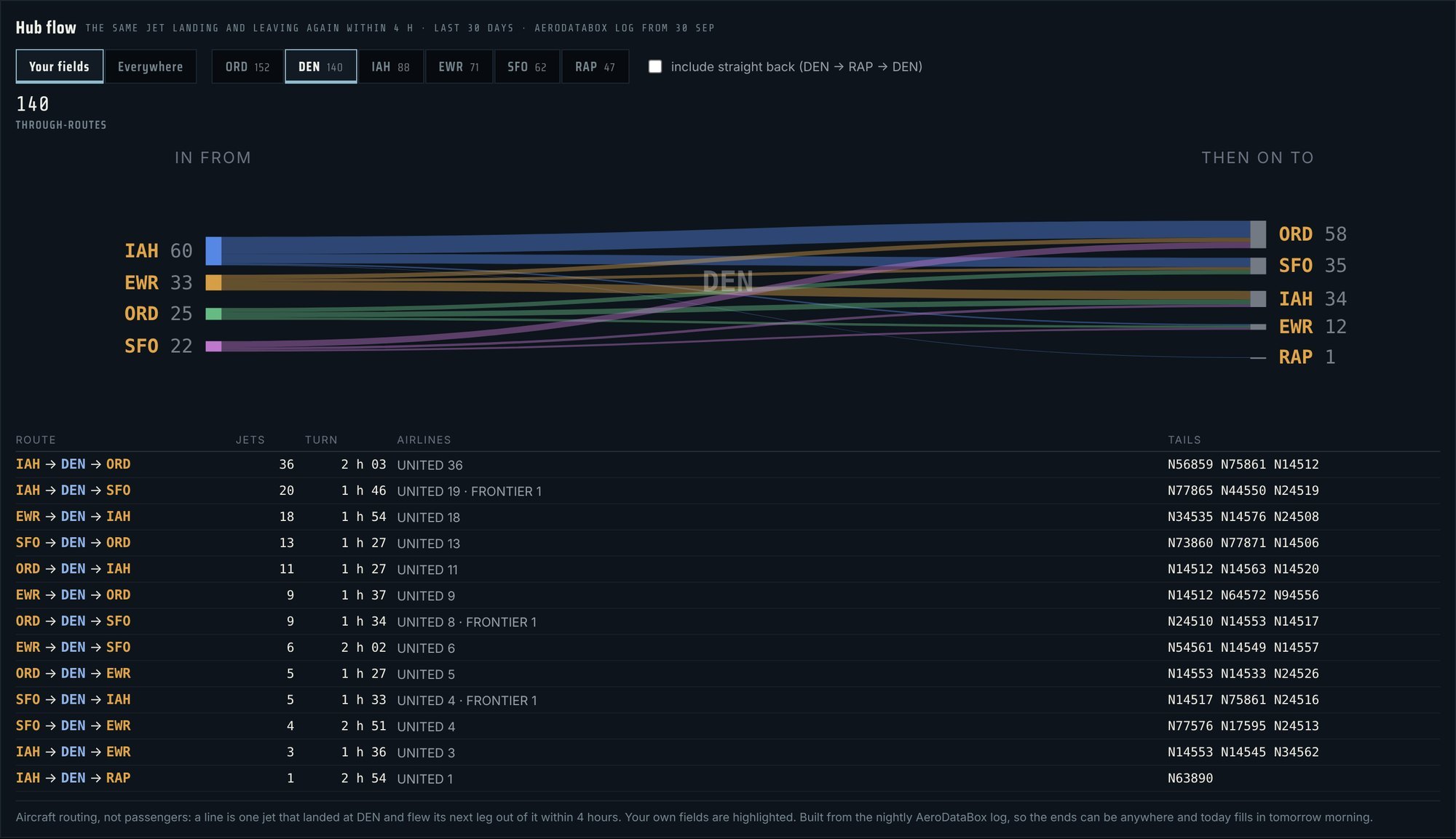
Rampline's hub flow view for Denver over 30 days: ribbons from inbound hubs on the left to outbound hubs on the right, and a table of through-routes such as Houston to Denver to O'Hare with jet counts, average time on the ground and example tail numbers.

Following one jet from hub to hub

Every jet that landed at Denver and flew its next leg out within four hours, over 30 days. The busiest line: 36 jets in from Houston and on to O'Hare. This is aircraft routing, not passengers: the hidden choreography of how an airline moves its fleet.

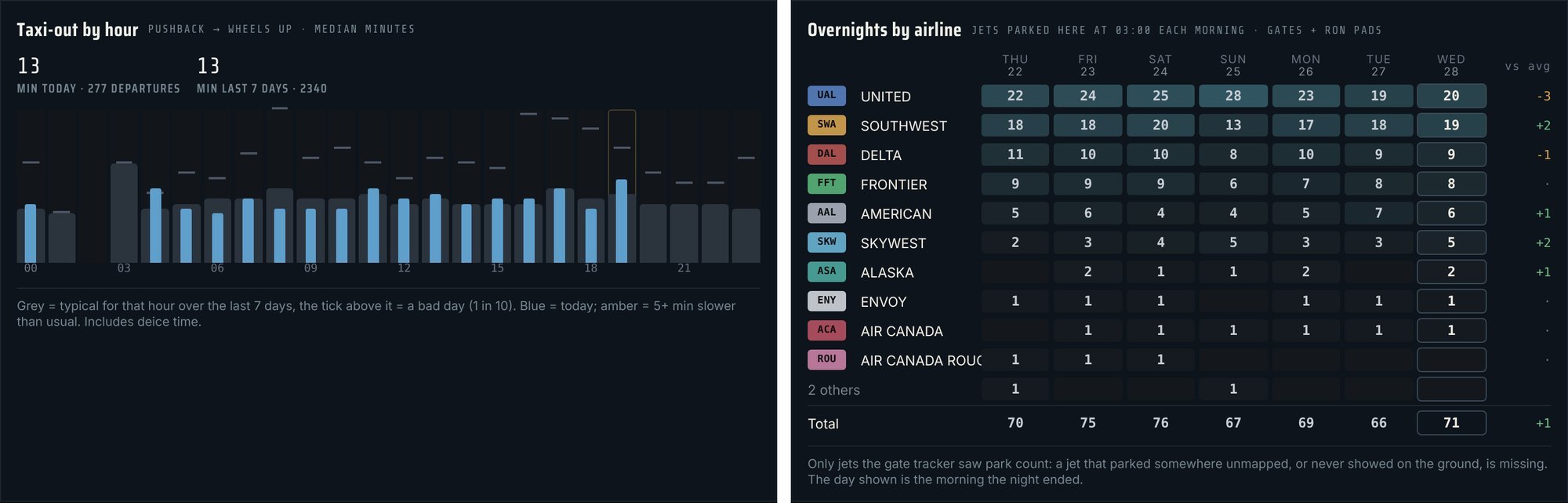
Two Rampline panels: taxi-out time by hour comparing today against a typical day, and a week of overnight aircraft counts at Denver by airline.

Taxi times and overnights

Pushback to wheels-up, hour by hour, against a typical day, so a backed-up evening jumps out. Next to it, how many jets each airline kept on the ground overnight, a week at a time.

Rampline's fuel and cost view for Denver, yesterday: about 12.8 million pounds of fuel, about 9.9 million dollars total cost and 940 departures, a cost bar split into fuel, landing fees, tires and brakes, and engine oil, then cost by airline and fuel by aircraft type.

What a day of flying costs

Yesterday at Denver: about 12.8 million pounds of fuel and $9.9 million to fly 940 departures, broken out by airline and by aircraft type. Rampline works each flight out from the aircraft type and distance and puts a price on it. It's an estimate, but only an airline normally gets to make one.

Rampline's deice view for Denver: counters for jets deiced today, this season and deice-weather days, all at zero, eleven deice pads watched, an empty 30-day chart, and panels for deicing by airline, recent stops and pad stops not counted.

Waiting for winter

Eleven deice pads drawn on the map. A jet only counts if it sits on a pad on its way out, in deice weather, for 4 to 75 minutes. Anything that doesn't qualify is listed with the reason, so a wrong rule is easy to spot. Every counter reads zero because the season hasn't started yet. The first cold morning in Denver will fill them in.

It grades itself against reality

Something most tools never do. Real-world sightings go into Rampline (a jet at a gate, a pushback, a jet out of service) and it grades itself against them. When it's wrong, it spells out exactly what it had and what was really there, so every miss points straight at what to fix.

Gate C57 · Denver · 5 Oct

A Southwest jet taxied out of C57 after a night on the ground, with someone we know on board. Rampline had it at that gate overnight and dropped it off the gate board the moment it pushed back. A passenger confirmed what Rampline had worked out from radio signals alone.

N722FR · Denver · 21 Oct

A Frontier A321 landed in the evening. An hour later it began transmitting under Frontier's maintenance call sign west of the B concourse, and six minutes after that it was inside the hangar area drawn on Rampline's map.

The thing the apps come from

Rampline will never ship. There's no download, no waitlist and no price. It exists to find out how far this can go.

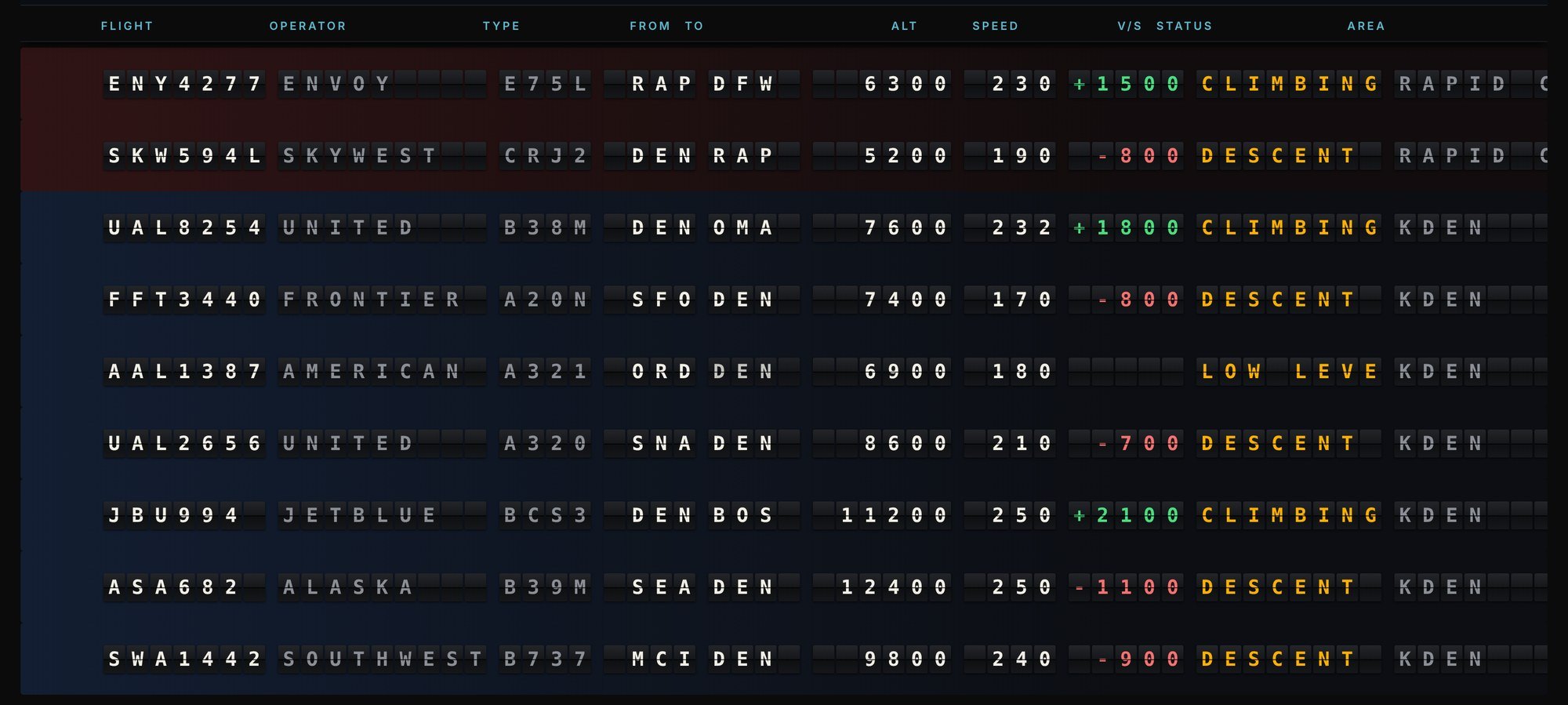
What gets proven here moves down the line. Rampline began as a split-flap board clicking over letter by letter, and that board became Overhead. The work of turning a bare transponder code into a tail number, an operator and an aircraft type, of mapping airports down to the gate, and of reading the weather the way pilots do is done at airline scale here first, then carried into the apps.

Rampline's original split-flap board: rows of flights spelled out on individual flap tiles with flight, operator, type, origin and destination, altitude, speed and status.
The original split-flap board, still built in. Flights shown are examples.

What it can't do

It only knows what the radios say

When a crew switches the transponder off at the gate, Rampline has to assume the jet is still there until it's heard from again. Some times are marked approximate for that reason.

Coverage isn't even

At Denver, 94% of jets are seen on the ground. At Houston on 28 October, Rampline saw 565 jets in the area and not one on the ground. It now counts the landings it misses there from jets that vanish on short final, and the nightly schedule log fills in the rest.

Guesses are labeled

Landings worked out from a vanishing jet and gates marked "probably here" are shown as inferences, not facts.

Costs are estimates

Fuel is worked out from aircraft type and distance. Nobody outside the airline knows the real fuel order or price.

Rampline uses only public information. It isn't an official source, it isn't for real flight decisions, and it isn't affiliated with or endorsed by any airline. Flights on the board screens are examples.